Why AI Coding Agent Bills Are So Hard to Predict (and What to Watch)
If your team runs AI coding agents, you have probably had this moment: the monthly bill arrives, it is higher than expected, and nobody can say exactly which runs caused it. Over the past two weeks, several reports and posts have landed on the same conclusion from different directions. The cost of a coding agent is less about the model's price list and more about what the agent does while it works.
Here is a summary of what people are saying, and what it means if you are trying to keep spend in check.
One developer, one month, three very different bills
On October 20, InferenceKey published a detailed breakdown of one developer's month with a coding agent. He used 26.2 billion tokens in 30 days. On a flat subscription that cost about $400. The same usage at one provider's API list price would have come to roughly $12,365; on a cheaper API, about $274.
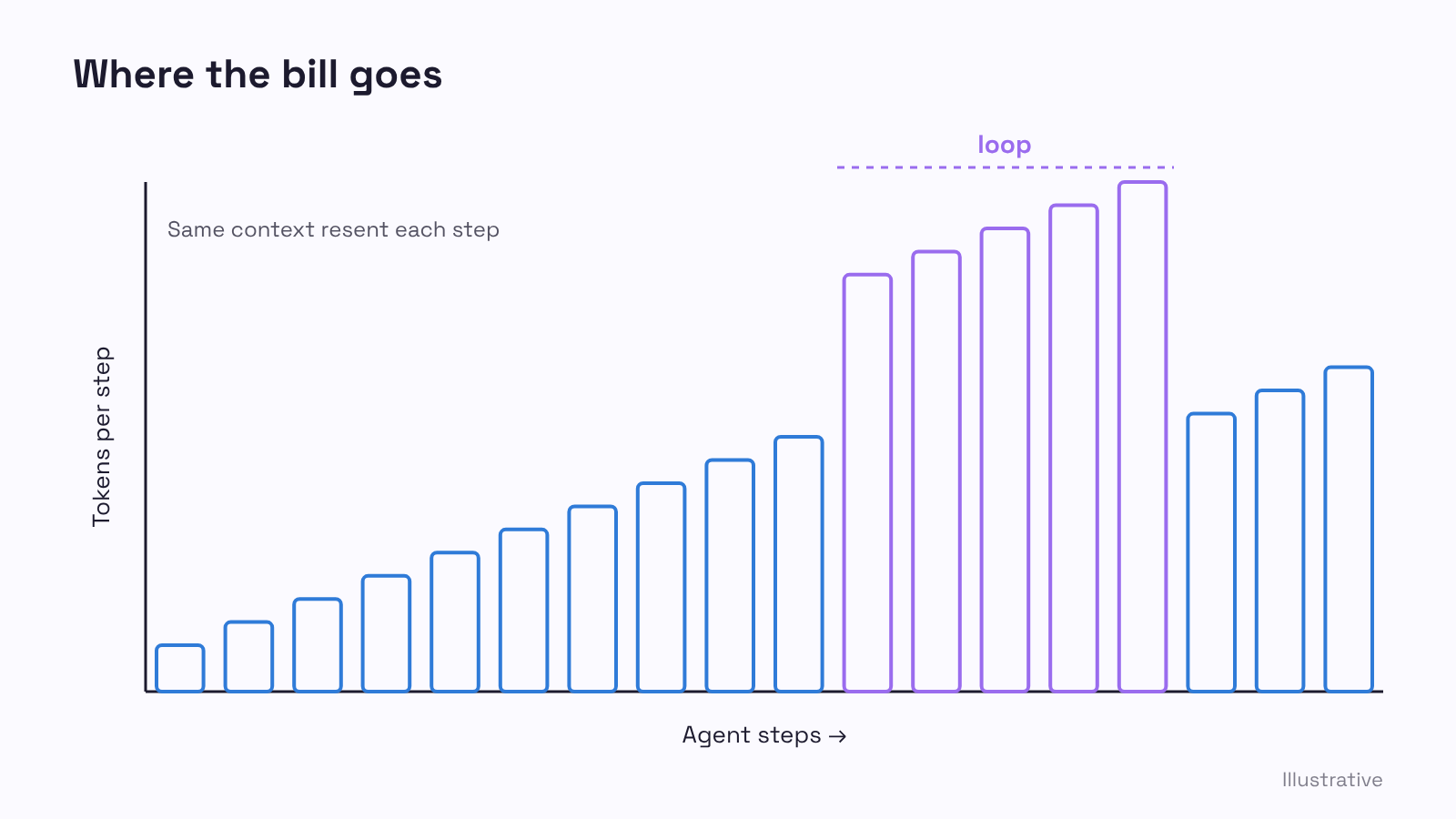
The headline is the spread, but the more useful detail is the volume. Billions of tokens a month from one person is not unusual for heavy agent use, and most of those tokens are not new code. They are the same context being sent back to the model again and again as the agent works through a task.
Most of the cost is re-reading, not writing
A research paper from university and industry researchers, "How Do AI Agents Spend Your Money?", looked at token use across eight frontier models on a standard coding benchmark. A few findings stand out:
- Agentic coding uses about 1,000x more tokens than code chat or single-step code reasoning.
- Input tokens, not output tokens, drive the cost. Each step re-sends a growing pile of context.
- The same task can vary by up to 30x in total tokens between runs.
- More tokens did not mean better results. Accuracy often peaked at a middle level of spend and flattened after that.
- Models are poor at predicting their own cost, and tend to underestimate it.
Those last two points matter for budgets. You cannot ask the agent how much a task will cost, and spending more does not reliably buy a better fix.
Benchmark trackers show the same pattern from another angle. The coding agent comparison charts on aicharts.io list cost per task ranging from under $0.50 to over $14 depending on model, harness and effort setting, with tokens per task from about 1.3 million to nearly 28 million.
Where the waste hides: loops and stalls
If the same task can cost 30x more on one run than another, the obvious question is what happens on the expensive runs. Two recent posts point at the same culprit.
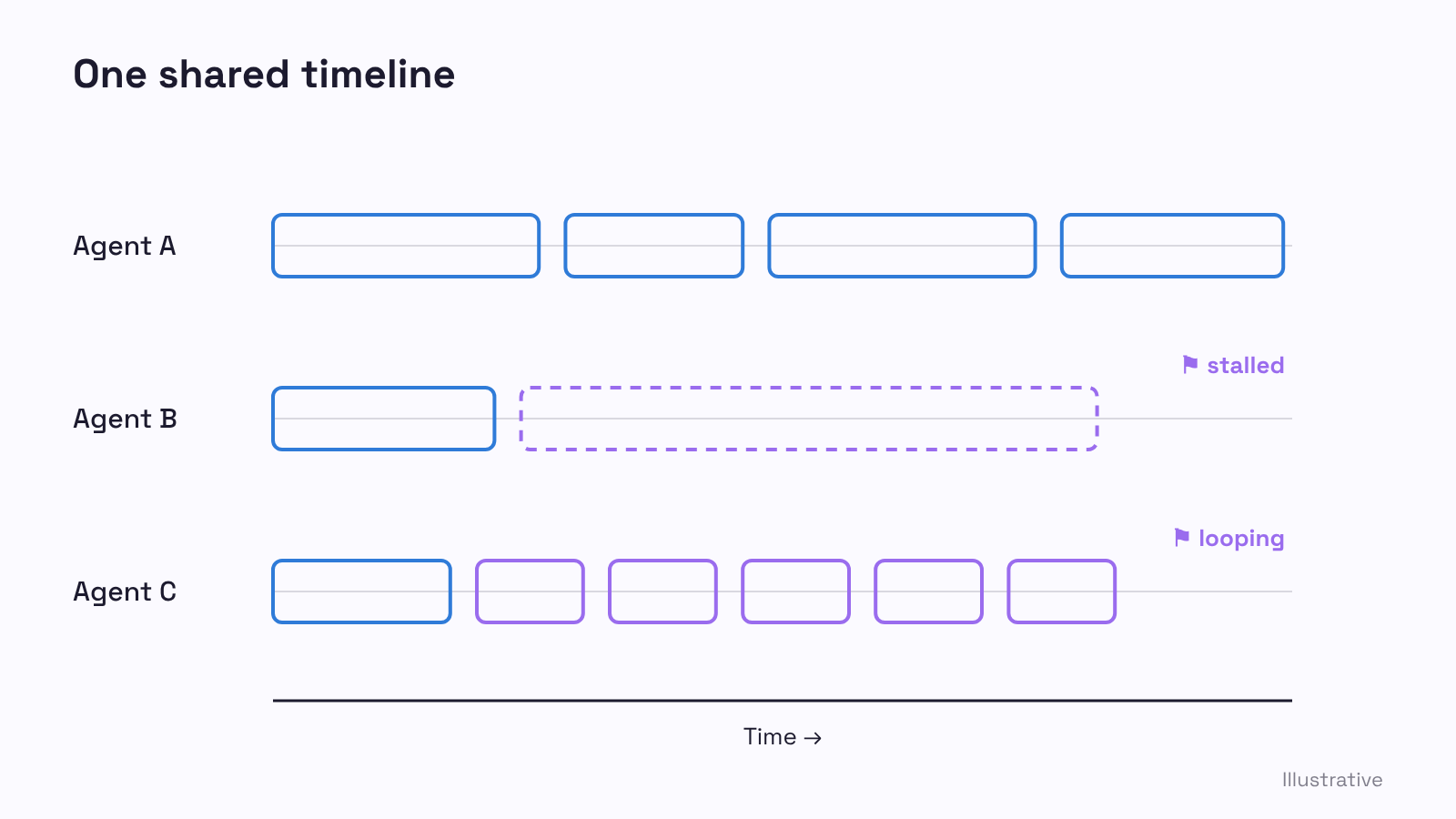
An October 21 post on the AWS containers blog, Observability patterns for AI agents on Amazon EKS, describes the problem plainly: an agent gets stuck in a loop calling the same tools repeatedly, burns tokens on steps that do not help, and traditional monitoring shows nothing wrong. A service returning a healthy response says nothing about whether the agent made progress.
A developer post from October 19, "Same Call, Same Result: A No-Progress Detector for Agent Tool Loops", gives a concrete picture: an agent sitting on one step for forty minutes, not frozen, but re-running the same search, getting the same result and re-planning the same fix. The author makes a sharp point. Token and latency charts rise smoothly during a loop, so there is no spike to catch. And the final answer often looks plausible, so the wasted spend is easy to miss.
The suggested fix is simple: give each tool call a signature (tool name, cleaned-up arguments, result) and count repeats. Same call with the same result, over and over, means no progress. The post is also honest about the limits: polling tools repeat by design, and an agent can loop in pure reasoning without calling any tool.
Model providers are moving in this direction too. One major provider announced on October 14 that its agent platform can now send standard traces of each agent turn, model call and tool use, so teams can follow what agents did step by step.
What this means for your team
Putting these together, a few practical lessons:
- Track sessions, not just invoices. A monthly total tells you that you spent money, not where. You need to see cost and tokens per run, per agent.
- Watch for no-progress patterns. Repeated identical tool calls and long stretches on one step are the clearest signs that a run is burning money. Catching them early is cheaper than reviewing them afterward.
- Do not assume more spend means a better result. The research suggests there is a point where extra tokens stop helping. Compare cost against outcomes.
- Expect your agents to underestimate. Budget from observed runs, not from the agent's own estimates.
- Plan for more than one model. Many teams already run agents on different models and tools. Tracking that only covers one provider leaves gaps.
- Keep caching on. Several sources note prompt caching cuts the cost of re-sent context substantially.
Where Hyoid fits
We built Hyoid Sessions because we kept running into exactly this problem: agents that looked busy, reported success and quietly ran up the bill.
Today, Hyoid Sessions gives you live tracking of AI coding agent sessions across agents and models, in one place. We're building it to flag runs that stall or loop, so you can step in while it still matters.
What is coming:
- Coming soon: share links, so you can send a live session to a teammate.
- In progress: a per-agent dashboard showing stage, tokens, cost and a step log; alerts when a secret appears to have leaked; and connectors for more AI coding tools.
- Planned: verified fixes, and cost per verified fix, so you can see what a working change actually cost, not just what was spent.
On privacy: by default, Hyoid receives session and tool-call details, not prompts, AI replies, tool inputs or outputs, file paths or code.
Our tagline is "Enough AI." It is not anti-AI. It means enough of agents running unseen, and enough of bills nobody can explain. If your team is running coding agents and wants to see what they are doing while they do it, we would like to hear from you.
Sources (accessed October 23, 2026): InferenceKey, Oct 20 · arXiv: How Do AI Agents Spend Your Money? · aicharts.io coding agent comparisons · AWS Containers Blog, Oct 21 · DEV Community, Oct 19 · Claude Platform announcement, Oct 14